
How High Can My Fence Be Without Council Approval?
One of the most frequent trade questions we receive at Sydney Fence Group is whether building a boundary fence requires local council approval. Under the New South Wales State Environmental Planning Policy (Exempt and Complying Development Codes) 2008, many standard residential fences qualify as "Exempt Development" — meaning you can build without submitting a Development Application (DA), provided you adhere to exact height and material limits.
In NSW residential zones, side and rear boundary fences up to 1.8 metres are generally exempt development, or 1.2 metres if masonry. Fences on a primary or secondary road boundary are limited to 1.2 metres. Heritage, critical habitat and bushfire-prone land have additional restrictions.
The Heights, In One Table
Here are the maximum allowable heights for residential fences under NSW Exempt Development rules:
| Boundary Location | Structure Type | Max Height Without Approval |
|---|---|---|
| Side & Rear Boundary | Non-Masonry (Colorbond, Timber, Slat) | 1.8 Metres |
| Side & Rear Boundary | Masonry (Brick, Concrete Block, Render) | 1.2 Metres |
| Primary Road Boundary (Front) | All Allowed Materials | 1.2 Metres |
| Secondary Road Setback (Corner Block) | Open / Slat / Tubular Panels | 1.2 Metres (+ Open Transparency Rules) |
Why Masonry Is Treated Differently
Heavy masonry walls (brick, rendered blockwork, stone) carry structural weight, wind load impacts, and footings depth requirements. For this reason, masonry walls over 1.2 metres require engineering details and council certification.
Homeowners seeking a modern rendered look without full council approvals frequently choose engineered modular walls. Explore our to see how light-core composite walls provide high acoustic reduction under standard exempt thresholds.
The Front Fence Transparency Rule
To maintain sightlines for motorists exiting driveways and preserve open streetscapes, fences constructed within the front building setback or secondary road boundary have strict transparency rules:
Secondary Road & Front Setback Rule:
Fences higher than 400mm must be at least 20% open or transparent above the 400mm mark, with solid posts or piers no wider than 350mm.
This transparency requirement is why horizontal aluminium slat fencing and tubular steel pickets are so dominant along Western Sydney front boundaries. See design examples on our .
NEED THIS DONE PROPERLY?
Need this done properly? Sydney Fence Group covers Penrith and all of Western Sydney, seven days a week. Call 0447 215 206 for a free on-site measure.
When The Exempt Rules Don't Apply At All
Standard exempt development rules do not apply to properties subject to specific environmental or heritage overlays:
- Properties listed on the State Heritage Register or subject to local heritage conservation orders
- Declared critical habitat or wilderness areas
- Properties in designated Bushfire Attack Level (BAL) zones where non-combustible materials or specific hardwoods are legally mandated
Suburbs located along the Nepean River or foothill bush land — such as Emu Plains, Emu Heights, and Leonay — feature extensive bushfire overlay mappings. Learn more on our .
What About Retaining Walls?
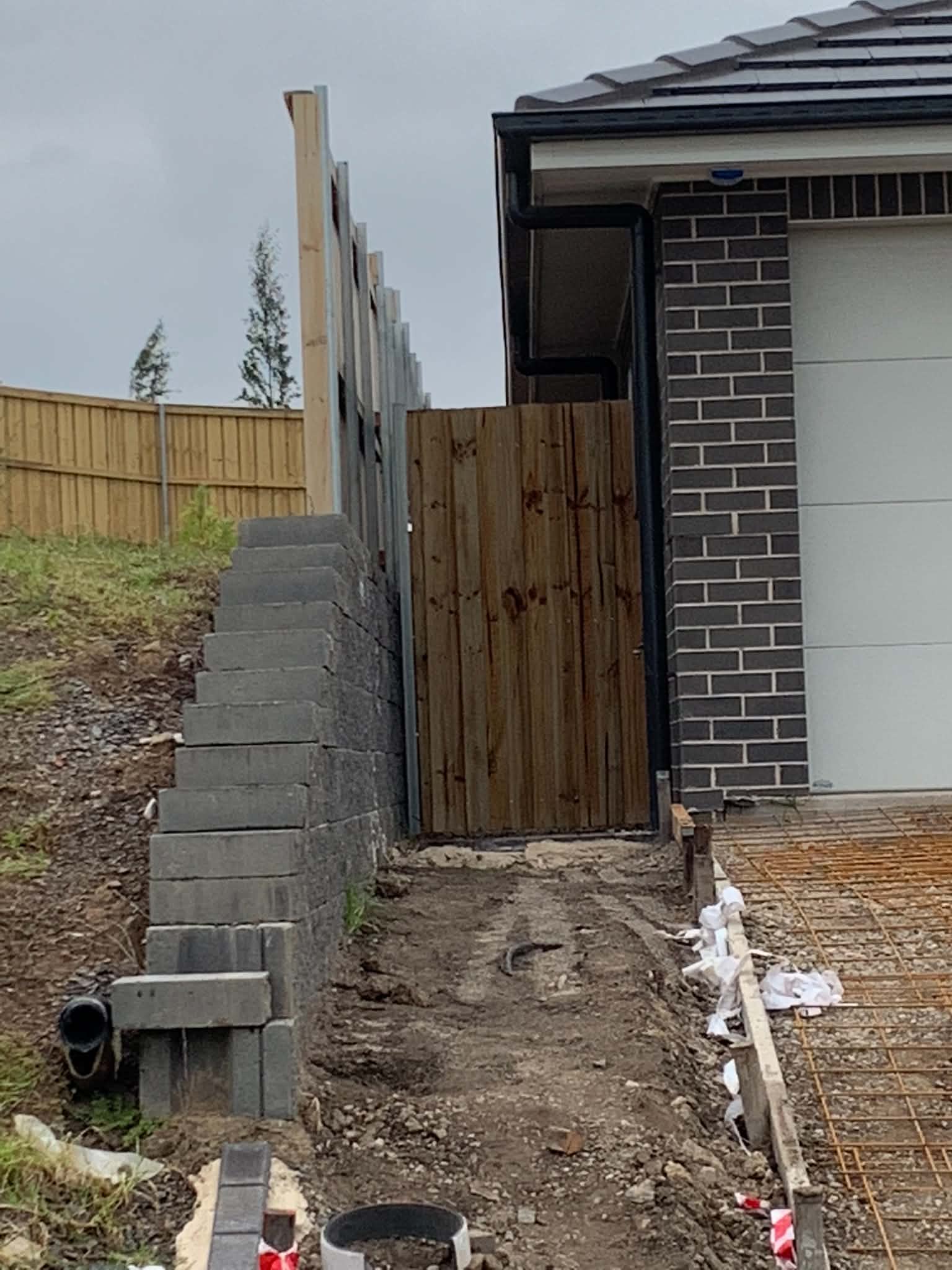
Retaining walls supporting soil along boundary lines are evaluated separately from fences. Retaining walls under 600mm height located at least 900mm from property boundaries are generally exempt. Taller walls or walls built directly on boundaries require engineering sign-off.
We specialize in concrete sleeper retaining walls integrated directly beneath boundary fences. Review our .
How To Check Your Own Block
Follow these four simple steps before selecting a fence design for your Western Sydney property:
- Check your land zoning (e.g. R2 Low Density Residential) on Penrith Council or NSW Planning Portal.
- Verify whether your address is mapped on bushfire-prone land or heritage registers.
- Measure whether the proposed fence sits on a primary road, secondary road, or internal boundary.
- Book an on-site measure with Sydney Fence Group — we verify site conditions before issuing your written quote.
This article is general information about NSW fencing rules, not legal advice. Rules change and every property is different — check with your council or a qualified adviser for your specific situation.
SYDNEY FENCE GROUP
PENRITH, NSWSydney Fence Group — fencing contractors based in Penrith with over 18 years experience across Western Sydney. Specialising in Colorbond, chainwire, security fencing, glass pool barriers, modular walls, timber palings and retaining wall combinations.
MORE FENCING GUIDES
Who Pays For A Fence Between Two Houses In NSW?
In NSW, the Dividing Fences Act 1991 says adjoining owners contribute equally to a dividing fence of a sufficient standard. If one owner wants better than sufficient, they pay the difference. Start by serving a Fencing Notice setting out the boundary, the proposed work and the estimated cost.
READ GUIDENSW Pool Fence Rules In Plain English
A NSW pool barrier must be at least 1.2 metres high, with no gap under it over 100 millimetres and no gap between vertical members over 100 millimetres. A 900 millimetre non-climbable zone must stay clear outside it, and the gate must be self-closing, self-latching, swing outward, and latch at 1.5 metres.
READ GUIDEChainwire vs Weldmesh vs Palisade: Which Security Fence?
Chainwire is the most economical over long perimeters and suits most yards. Weldmesh is much harder to cut or climb while keeping a clear sightline, so it suits higher-security sites. Palisade is the strongest visual deterrent and the hardest to breach by hand. Most sites use a mix.
READ GUIDE